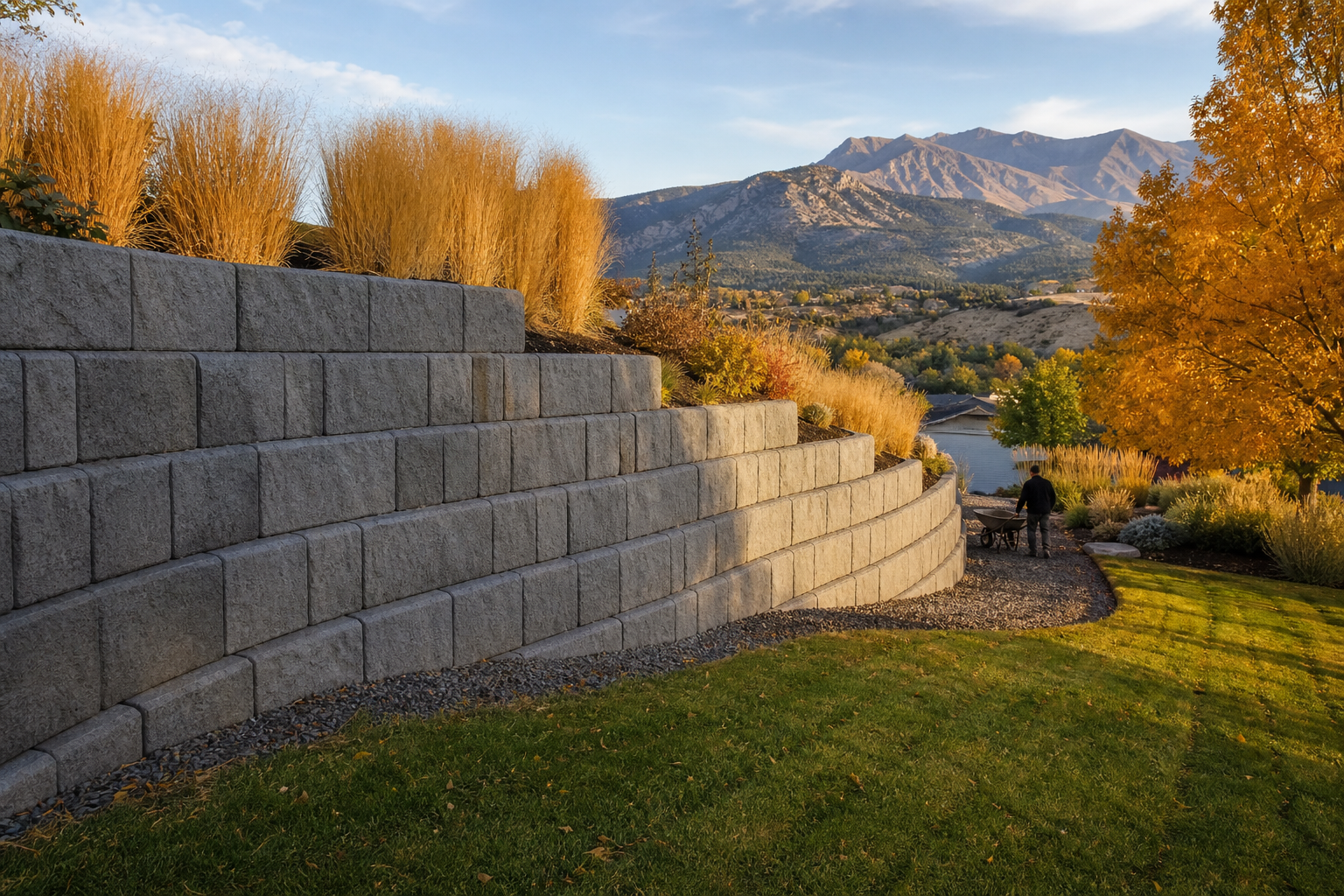
Retaining Wall Drainage Before Winter: Why Water, Not Weight, Breaks Walls
Most failed retaining walls in Utah County were not defeated by the weight of the soil behind them. They were defeated by water.
Retaining walls are engineered to hold back a certain load. What tips them past that load is saturated soil — which is dramatically heavier than dry soil — and, in our climate, water that freezes behind the wall and expands. Get the drainage right and a wall will stand for decades. Get it wrong and it will lean, bulge, crack and eventually fail, no matter how good the block looks.
Fall is the right time to think about this, because winter is when walls get tested hardest.
What actually pushes a wall over
A retaining wall resists lateral earth pressure — soil pushing sideways. Two things increase that pressure beyond what the wall was built for:
Hydrostatic pressure. When water cannot drain out from behind a wall, it builds up and pushes. Water is heavy, and saturated soil is far heavier than the same soil dry. A wall perfectly adequate for dry conditions can be badly overloaded when the ground behind it is holding water with nowhere to go.
Frost action. Water in the soil behind a wall freezes and expands. Repeated through the freeze-thaw cycles of a Utah winter, that expansion works incrementally against the structure. It shows up as blocks pushed out of alignment, a wall that leans a little further each spring, and cracking at corners.
Both are water problems. Both are preventable at build time and often correctable afterward.
The parts of a wall you cannot see
When a wall is built properly, most of the important work is invisible once the job is done:
A compacted base. The wall sits on a level, compacted base of gravel below grade. Skimp here and the wall settles unevenly no matter what happens above.
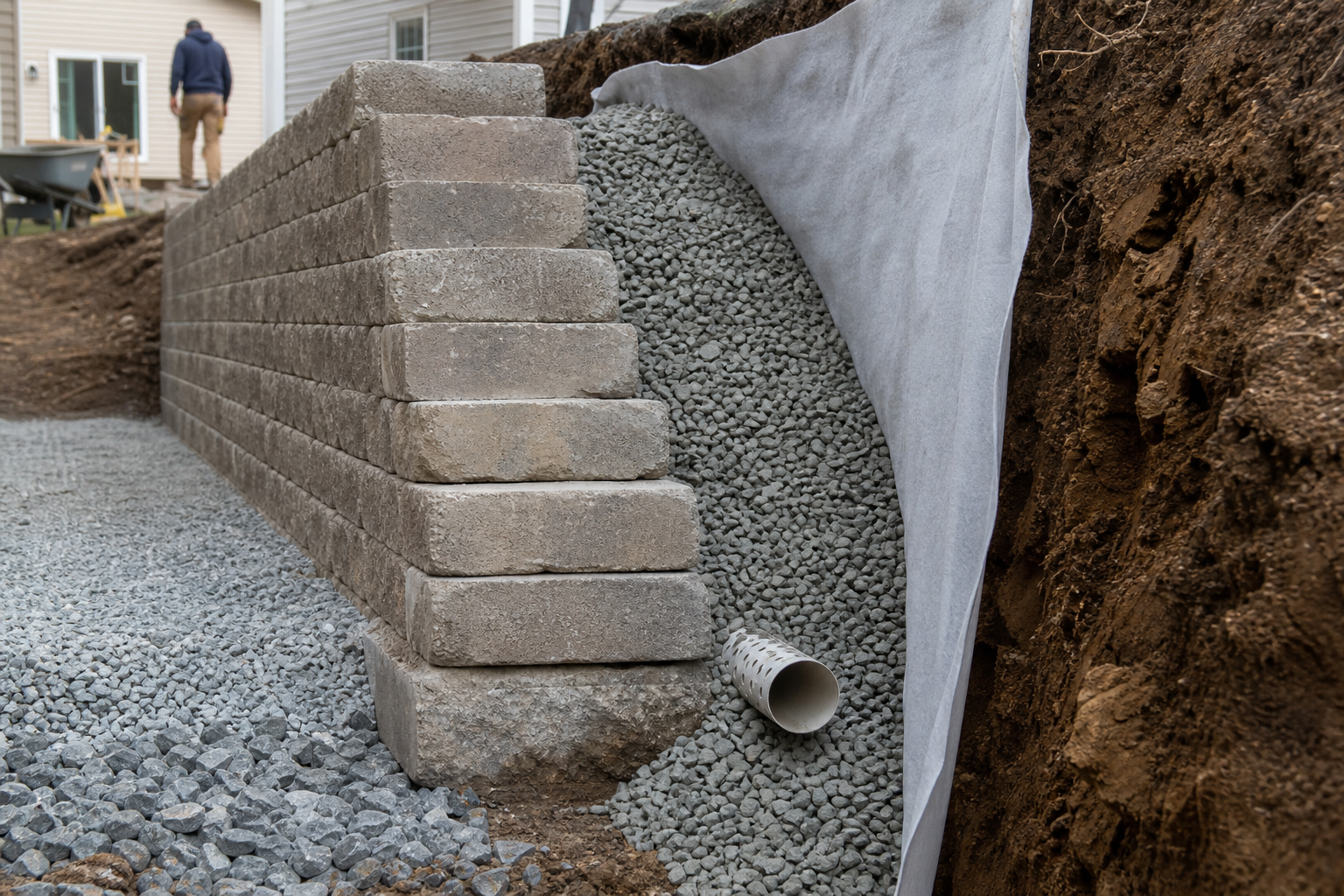
Free-draining backfill. A zone of clean gravel directly behind the wall, rather than native soil packed against the back of the blocks. Gravel lets water move down and out instead of accumulating. Native clay-heavy soil packed against the wall traps water.
A drain pipe at the base. Perforated pipe running along the bottom of the gravel zone, sloped to daylight or to an outlet. This is what actually removes the water. A wall with gravel but no functioning outlet is a bathtub.
Geotextile separation. Fabric between the gravel and the native soil, so fine particles do not migrate into the gravel and gradually clog the drainage zone. This is the component most often skipped, and it is why some walls drain beautifully for five years and poorly after ten.
Surface grading above the wall. The ground above should shed water away from the top of the wall, not funnel it in. A downspout discharging behind a retaining wall is a remarkably common and completely avoidable mistake.
Reinforcement where required. Taller walls generally need geogrid reinforcement extending back into the retained soil, and past a certain height they need engineering and a permit. Height thresholds vary by jurisdiction — your local building department sets the rule.
Warning signs to look for this fall
Walk your walls before winter and look for:
- Leaning or bulging — any section tipping outward or bowing in the middle
- Blocks out of line — courses that no longer run straight
- Cracking, particularly stair-step cracking or cracks at corners
- Water staining or persistent damp at the wall face, which suggests water is finding its way through rather than out the drain
- No visible drain outlet — if you cannot find where the water is supposed to exit, that is worth investigating
- Soggy ground or settlement above the wall, which often means water is collecting behind it
- Separation at the top — a gap opening between the wall and the soil behind it
Movement is progressive. A wall that has shifted slightly will usually shift more, because the same forces are still acting and the structure is now less able to resist them. Catching it early is the difference between a drainage correction and a rebuild.
Simple things worth doing before the freeze
Some of the most effective fixes are not construction projects at all:
Redirect your downspouts. Water from a roof concentrated near a retaining wall is a large volume in a small area. Extend the discharge well past the wall.
Clear the drain outlets. If your wall has weep holes or a daylighted drain pipe, make sure they are not blocked by soil, mulch, landscaping or debris. A blocked outlet turns a drainage system into a reservoir.
Fix the grade above. If the ground behind the wall slopes toward it, water is being delivered straight to the problem area.
Watch irrigation. Sprinklers running against a wall all summer add up. Check for lines leaking near the wall before you blow the system out for winter.
Do not stack snow against it. Plowed and shoveled snow piled against a wall becomes concentrated meltwater in exactly the wrong place.
When it is time to rebuild
A wall that is leaning significantly, has lost its structural integrity, or is retaining soil near a structure is not a candidate for patching. Rebuilding correctly — proper base, proper drainage, proper reinforcement — costs more than a cosmetic repair and lasts orders of magnitude longer.
Fall is a reasonable time to do this work while the ground is firm and dry, provided the job can be completed and the site left stable before hard freeze.
Smooth Hollow Excavating builds retaining walls, drainage systems and grading solutions throughout Wasatch, Summit, Utah and Salt Lake counties, including Heber, Midway, Kamas, Provo, Orem, Springville, American Fork and Lehi. If a wall on your property is showing any of the signs above, send us photos and details and we will tell you whether you are looking at a drainage fix or a rebuild.
